
The Borrowed Life
On the films that gave us our language

“I carried a watermelon?”
I have.
I have literally carried one with my own two hands. I further suspect most of us have said some version of that line out loud in a room, right after doing or saying the most awkward possible thing. You open your mouth to recover, and what comes out instead is the thing that needed no saying. The obvious thing. The thing that makes the silence louder. “I carried a watermelon.”
I say it probably more than any other phrase in my daily life, which is a strange thing to admit about a quote from a 1987 romantic drama set in the Catskills. I say it in meetings when I’ve just said exactly the wrong thing. I say it when one of my many jokes lands flat and the pause stretches just a beat too long. I say it the way other people clear their throats or laugh quietly at themselves. It’s a souvenir from someone else’s embarrassing moment, and I borrow it freely because it fits my own life more often than I’d like to acknowledge.
But I have to be honest, it might not even be my favorite quote.
My favorite quote is “Utah, get me two.”
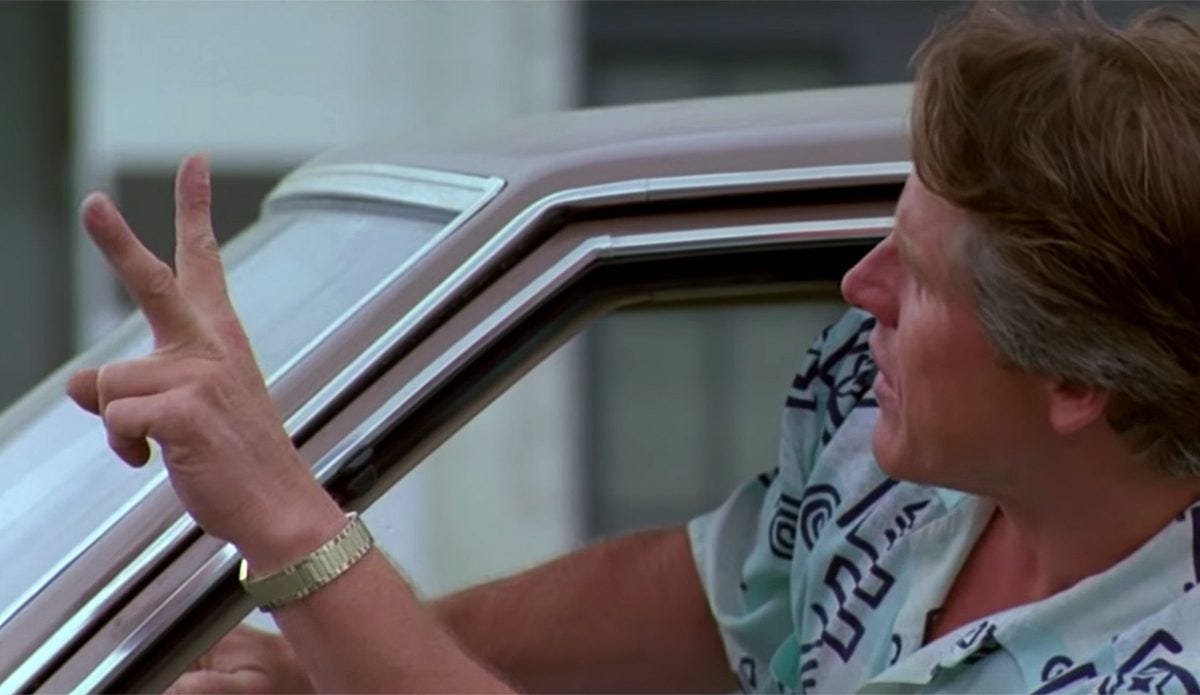
Point Break. 1991. Gary Busey, playing FBI Agent Angelo Pappas, says it to Keanu Reeves before they go into a bank they suspect is about to be robbed. He’s ordering meatball sandwiches. The bank is about to explode into chaos. And he wants two. Not one. Two. I can’t fully explain why this line lives in me the way it does except to say that it represents something I aspire to: the perfect combination of total incompetence and complete calm, the person who has seen enough to know that whatever’s about to happen, you should probably eat first. I use it constantly. I use it in situations that have nothing to do with sandwiches, banks, or Keanu Reeves. It just works. It always works. The sheer confidence of it. The priorities of it. “Utah, get me two.”
This is what I want to write about.
Not movies as art or culture or awards-season conversation. I want to write about what they actually do to you. The way they live inside you when you’re not thinking about them. The way they become part of the language you reach for when your own words aren’t quite enough.
I know this isn’t a new idea. Roger Ebert called movies “a machine that generates empathy.” But Ebert was writing for everyone. I’m writing this for myself and maybe a few friends who use movies in the same way. I’m writing it for the kid I was, and for the dad I am now, and for the particular way those two people keep finding each other on a summer night when a movie starts, and the proverbial lights go down.
The Great Outdoors is the unofficial kickoff of our summer. Every year, first warm night we can manage it, the projector goes up, Goose my Dude takes his spot at my feet, the kids grab blankets they don’t need, and I light a cigar. No negotiation. No debate. Just the movie.
And every year, within minutes, we’re all inside it.
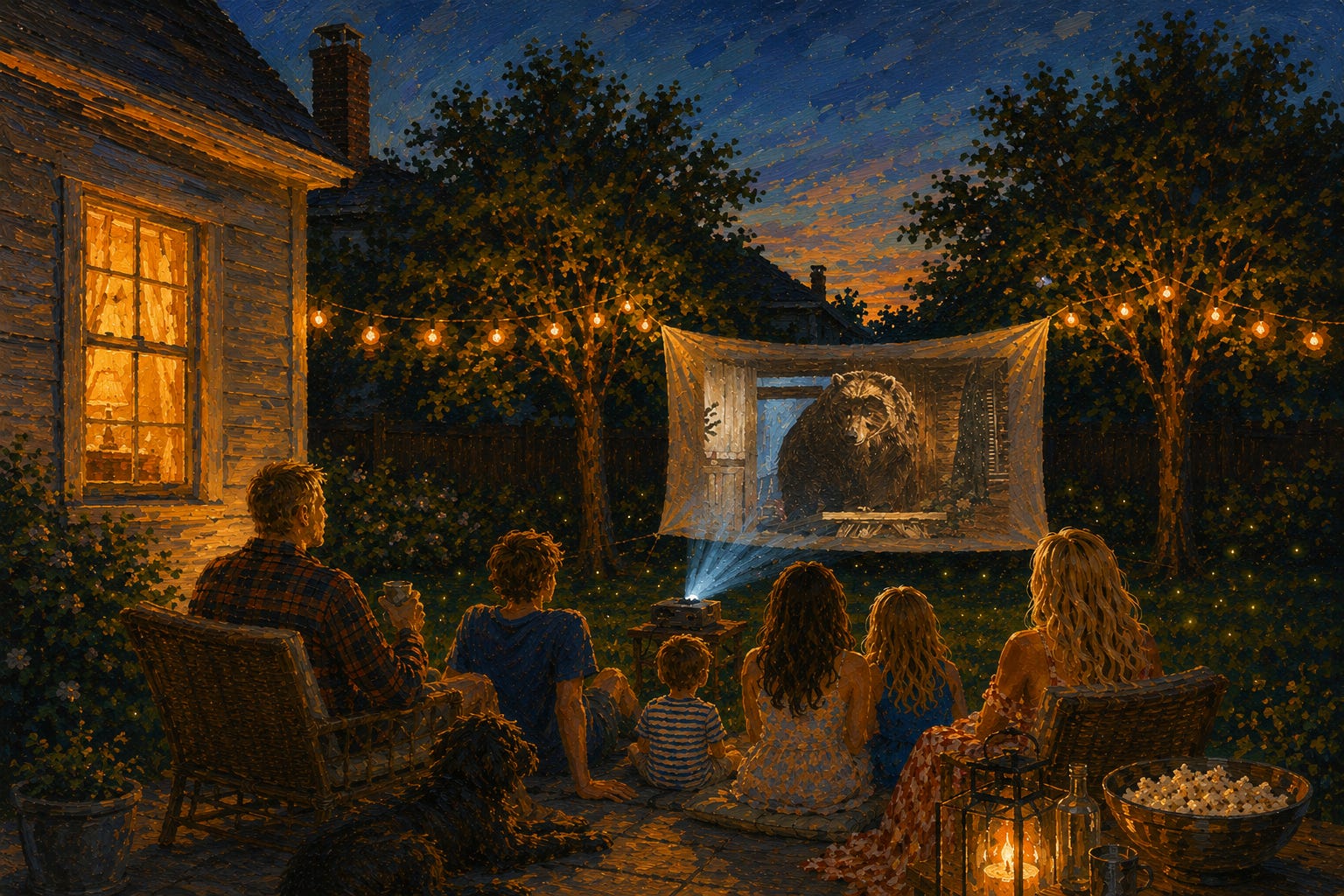
John Candy and Dan Aykroyd don’t get enough credit for what they’re actually doing in that film. The bear and the raccoons and the ‘ol 96er are all great, but the movie that stays with me is the one happening between Chet and Roman. Two brothers-in-law who love each other and have spent half a lifetime disappointing each other in the specific way that only family can. Candy plays Chet like a man who loves his family too much to stop trying, three years before Clark Griswold made that particular dad a household analogy. Aykroyd plays Roman as so overconfident, so relentlessly performative about his own success, that you almost miss the desperate need for approval running just underneath it. Kids laugh at the raccoons. But they feel that part too, even if they can’t tell you why yet.
That’s the easiest kind of movie connection. The rhyming kind. But I don’t think it’s the most interesting kind.
Later that night, after everyone had gone inside, I watched Dirty Dancing (probably second only to The Devil Wears Prada as my guilty pleasure flick).
I’ve seen it countless times. I know every beat. And when Johnny walks into that room at the end and says nobody puts Baby in a corner, and she takes his hand, and they walk toward that stage together, I smiled before I had a single thought about smiling. And then, naturally and involuntarily, I weld up.
I want to be honest about this because I think it matters lest there be any confusion. I have no biographical connection to that story and I’m not Johnny Castle. I didn’t spend summers at Kellerman’s, or anywhere that looks like Kellerman’s. The world of that film is not my world in any external sense.
And yet it hits me every single time.
And the soundtrack. God, the soundtrack. “(I’ve Had) The Time of My Life” is essentially a mixtape closer, the song you put last on Side B because everything after it would feel like a letdown. It earns its ending. The whole film does. But you can’t separate what the music does from what the people on screen are doing. We’re singing along to and about something real because the dancing ensamble are feeling something real, and somehow that transaction completes itself through the screen and lands in your chest, whether you’ve ever set foot at Kellermans or not.
What moves me in that final scene isn’t dance. It’s not romance or nostalgia for a decade I didn’t live through (although we are looking for a Kellerman’s type spot for a family vacation). It’s someone publicly choosing another person. It’s dignity. It’s the refusal to let someone be made smaller by a room that has already decided who they are. It’s the belief that love should be visible, celebrated, and that it shows up as action, so that it cannot be shamed into hiding.
“I’m right on top of that, Rose.”
Don’t Tell Mom the Babysitter’s Dead. 1991. Christina Applegate plays a teenager holding a professional job she has absolutely no business holding, keeping it together through borrowed confidence and sheer nerve. She delivers that line as a way of projecting competence she doesn’t fully have, and it is one of the most accurate descriptions of professional life I have ever encountered in any medium.
I say it when something is technically not yet handled but will be, when the wheels are in motion and the situation is under control in the loosest, most meaningful sense of that phrase. It names something true about the particular comedy of trying to appear like you know what you’re doing when you are, in fact, figuring it out alongside everyone else.
I’m not sure who in my professional orbit has necessarily seen this movie. It doesn’t matter. The line still lands. That’s what movie quotes really are: shorthand for emotional experiences that don’t always have good words. They’re the thing you reach for when what you want to say is complicated and the situation calls for something quicker and truer.
The mixtape piece I wrote a few months ago was really about the same thing. A song title on a J-card spine is its own kind of shorthand. Born on the 4th of July. Make Out Songs Vol. 2. Crowded Pool Bar. You didn’t need to hear the tape to understand what it was saying about the person who made it. Movies work the same way. The titles we carry around with us, the quotes we reach for, the scenes we return to, they’re the songs on Side A of whoever we are.
Grayson and I grew up watching Marvel movies together, and I want to say something specific about why, because superhero movies are easy to dismiss, and I don’t think the dismissal is entirely fair.
We weren’t watching because we thought we’d go to space tomorrow. We were watching because those movies kept making a case for something genuinely hard to believe in when you spend any time reading the news. They kept saying: people can be better than this. Ordinary people. Scared, flawed, self-interested people can still, when it matters, choose something larger than themselves.
Robert Downey Jr. built something over a decade of those films that I don’t think has a real precedent. Tony Stark started as the most self-interested person in any room and became someone who gave everything he had for people he’d never meet. That arc worked because Downey made you believe both ends of it. The arrogance and the sacrifice. You couldn’t have one without the other, and he never let you forget that the sacrifice cost something real.
Nobody leaves Avengers: Endgame thinking they’re going to wield a hammer or reverse time. But you might leave believing that sacrifice is real. That loyalty is real. That when the moment arrives, someone will stand up. That one day, we’ll get to say in some fashion: “I am Ironman.”
That feeling has a sound, and I found it recently in the most unexpected place.
Project Hail Mary uses Harry Styles’ “Sign of the Times” in a way I was completely unprepared for. If you haven’t seen the film I won’t give you the full context, but here is what I can tell you: there is a moment when that song arrives and it is not ironic, it is not nostalgic, it is not background. It is the exact emotional truth of what is happening on screen: a story about a human being who wakes up alone in space with no memory, slowly piecing together that he might be the last hope for everything, and choosing to keep going anyway. When that song came in, I cried the way I cry at the end of Dirty Dancing, before I had decided to, before I had time to explain it to myself.
“We never learn, we’ve been here before. Why are we always stuck and running from the bullets?”
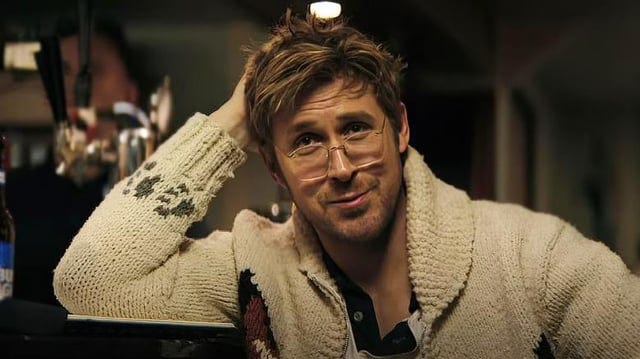
Harry Styles wrote that song about a broken world and the terrifying freedom of having no choice but to hope anyway. The movie found the one scene in which those words mean everything, and I sat in the dark theater and felt it completely. That’s what I mean when I say I watch Marvel movies because I need to believe humanity is capable of better. Sometimes the feeling arrives through a superhero. Sometimes it arrives through an astronaut alone in the void with nothing but the decision to keep going. Sometimes it arrives through a Harry Styles song. Go figure.
The Godfather is not really about organized crime. It’s about community. About who you decide your people are and what you owe them. Marlon Brando understood that the Don’s power came from stillness, from the sense that he had already thought of everything and was just waiting for you to catch up. But what I think about when I watch that film isn’t the violence or the mythology. It’s the neighborhood. The way everyone on that street knows each other. The way people show up. The way problems get solved at the local level, by people who actually have to live next to each other afterward.
“A man who doesn’t spend time with his family can never be a real man.”
It’s not about crime at all. It’s about presence. About showing up. About the belief that your first and most fundamental obligation is to the people closest to you, not to some abstract cause or distant institution. The Don says it like it’s the most obvious thing in the world, because to him it is.
We’ve drifted a long way from that. Not into crime, but into something I think is its own kind of loss. We’ve convinced ourselves that Washington is our fundamental political community, that the arguments happening on cable news are the ones that actually define our lives. But I don’t think that’s true, and I don’t think most people actually feel it to be true when they’re being honest. Your neighborhood is your community. Your city hall is your community. The people you’d call if something went wrong at two in the morning, that’s your community. The Corleones got a lot wrong. But they knew who their people were, and they showed up for them. I think about that more than I probably should for someone watching a movie about a crime family.
Rocky isn’t about boxing. It’s about dignity and hope. Bill Conti’s score is basically a mixtape in itself, the kind of thing you put on when you need to believe the thing you’re about to attempt is actually possible. “Gonna Fly Now” is on every running playlist ever made for exactly that reason. It found the truth in the moment.
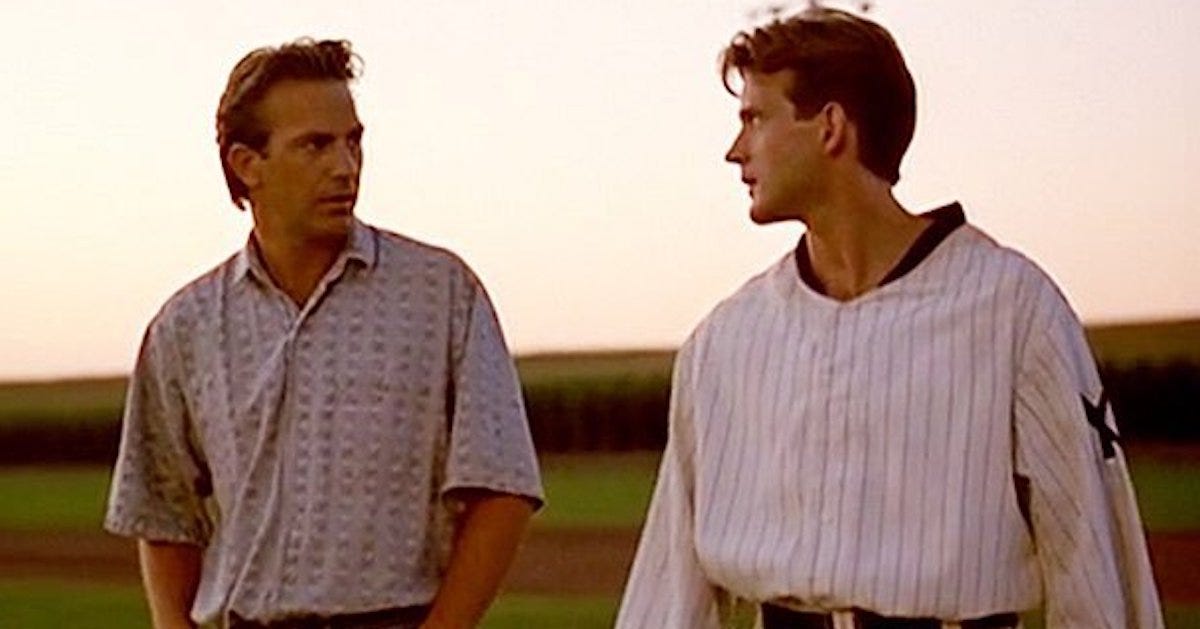
Field of Dreams isn’t about baseball. It’s about fathers. About conversations you never got to finish. Kevin Costner standing in that field when his father walks out of the corn and asking him if he wants to have a catch is one of the most honest moments American cinema has ever produced, and it works because James Earl Jones had already spent twenty minutes building the case that some things are worth believing in even when the world tells you you’re crazy.
What I keep coming back to is what movies have done for me as a father and as a friend.
They create a shared language. Reference points. The particular intimacy of people who have laughed at the same things and sat in the dark, having the same private experience at the same time. That’s what my mixtape crew does, still, trading Spotify links and having too-long text messages about what made the cut and why. The medium changed. The instinct didn’t. We are still curating our way through our own lives, still reaching for the songs and scenes that name the thing we’re feeling.
My kids may not remember every plot detail of every movie we’ve watched together. But they’ll remember the patio. The warm night. The sound of all of us laughing in the same direction. A summer that felt whole while we were in it.
And someday, years from now, one of them will come across The Great Outdoors, or something we watched together, and something will go quiet in them, and they’ll find themselves back there. Not exactly as memory, but as feeling. The way “Fade Into You” can drop you back into a specific room in a specific year before you’ve even consciously recognized the song.
That’s the quiet gift movies have given me my whole life. Not escape. Not a distraction. A place to return to. A way to stay connected to people, moments, and versions of myself that would otherwise slip away.
I was a kid who borrowed other people’s words for the moments when my own weren’t quite right. This is the language we built together:
Nobody puts Baby in a corner.
Utah, get me two.
I’m right on top of that, Rose.
This isn’t just shorthand for movies we’ve seen. It’s proof we were in the same room, feeling the same thing, at the same time. That’s not nothing. That’s actually everything.
Life moves fast. If you don't stop and look around once in a while, you could miss it.
Two random quotes come to mind constantly and are useful on almost all occasions:
“I’ve spoken my piece and counted to three.”
“But the bell rang!”